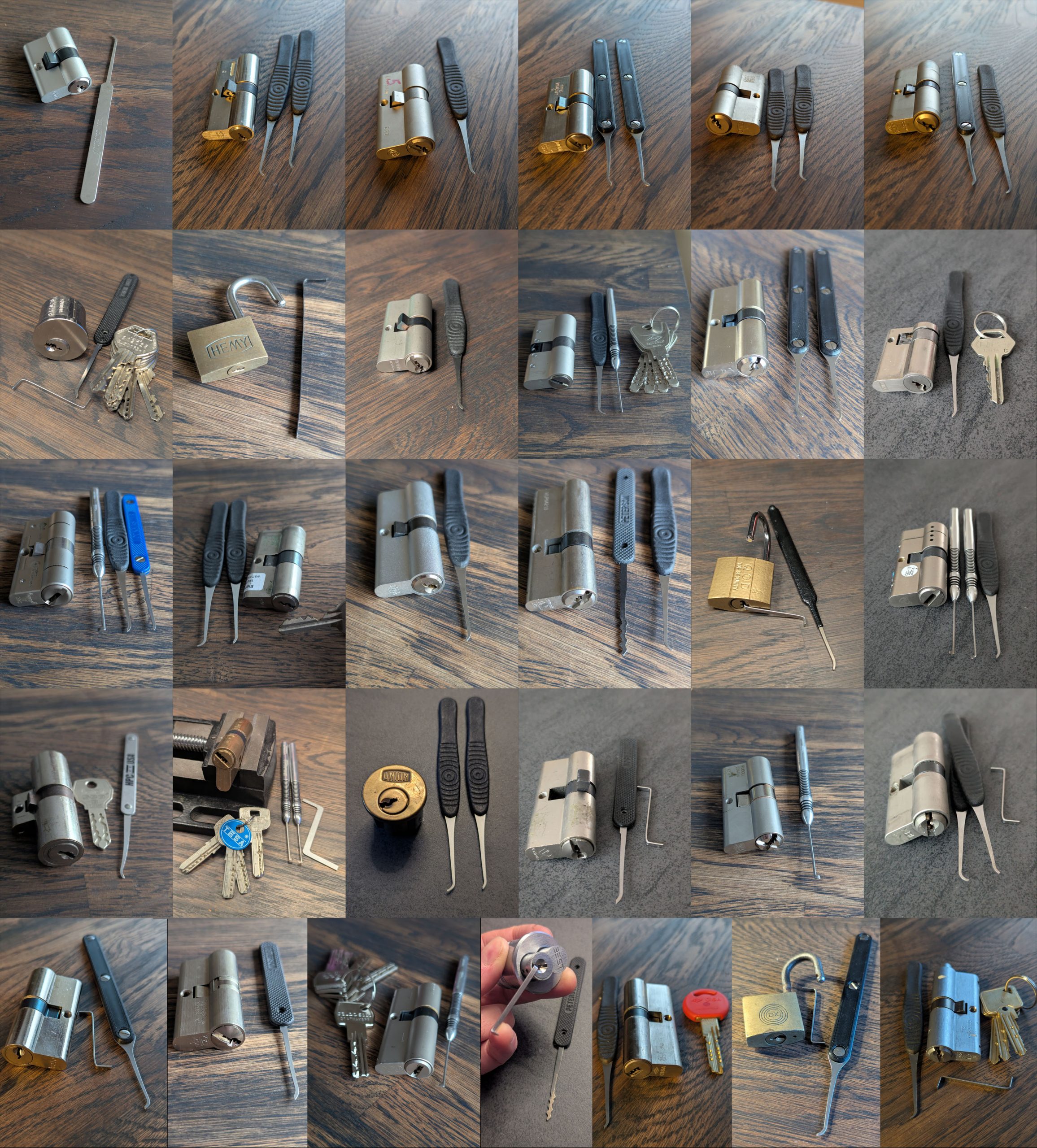
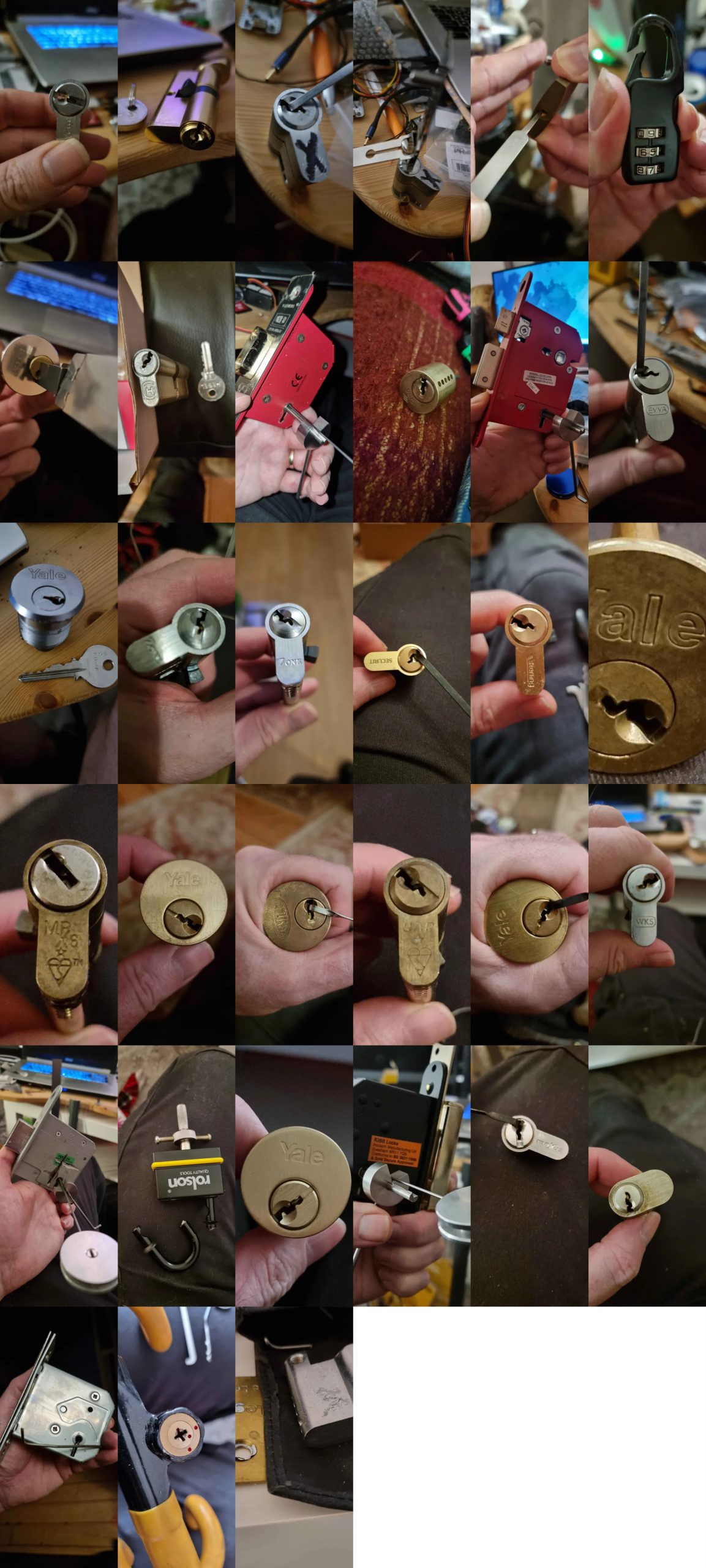
We’ve written about the January Lockpicking Challenge (originally from UKLS) the past few years. This year, due to circumstances, not many from Toool NL were participating, but I decided to do so and give it a little extra twist: I picked the alphabet!
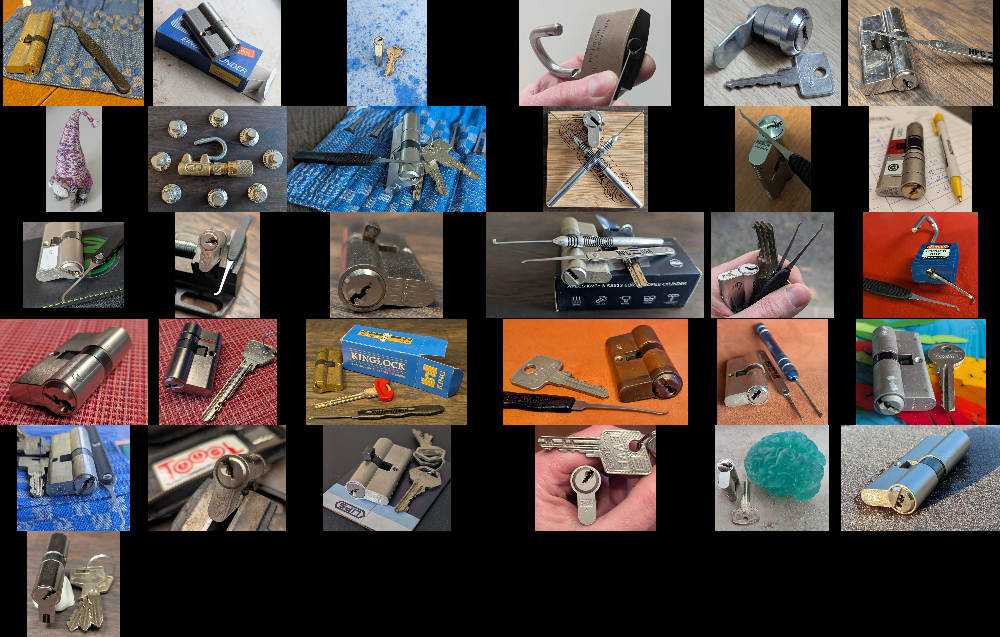
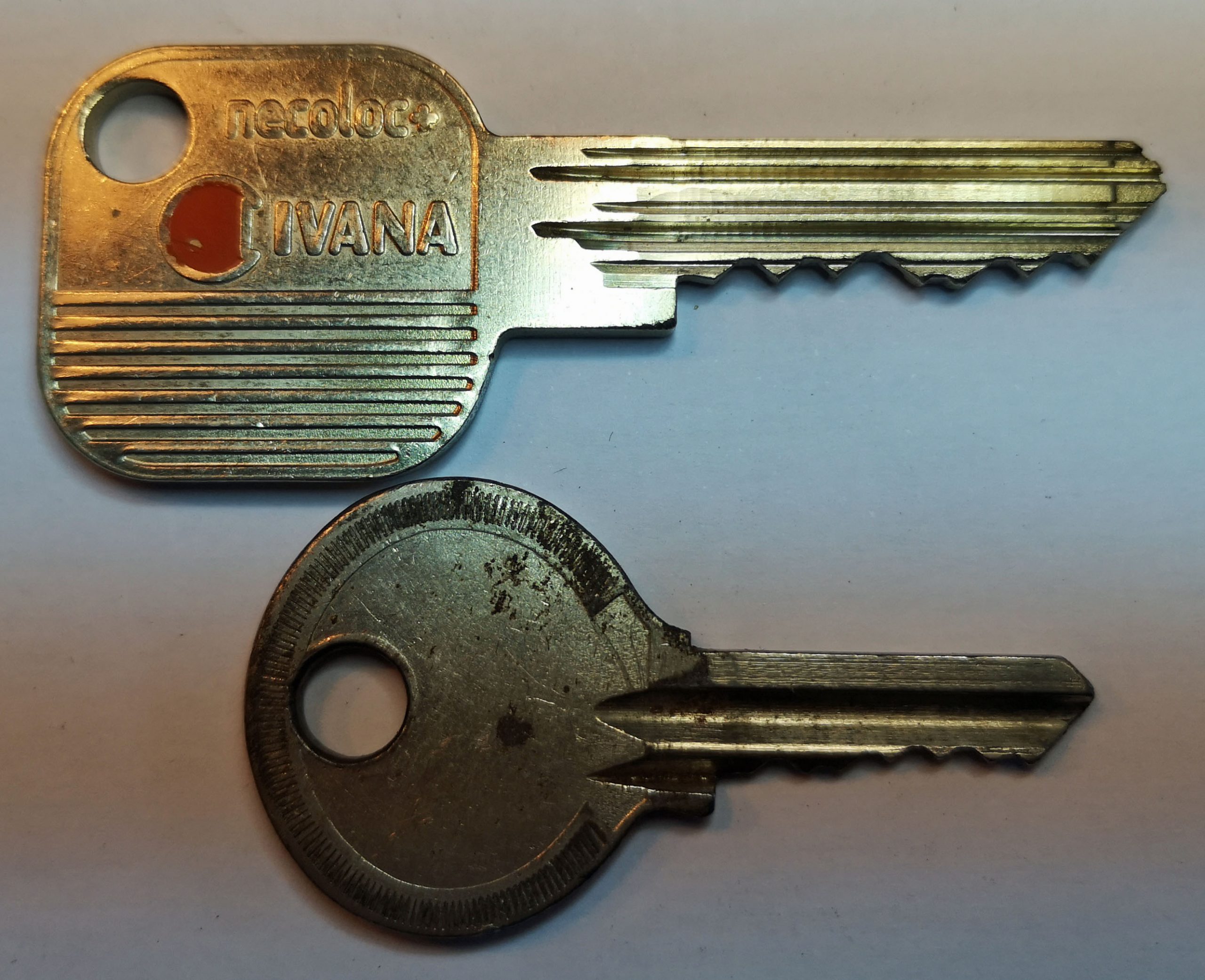
The locks picked were: Abus (3-pin), BKS, CES, DOM Sigma, EVVA, Federal, Gege AP3000, HEMY padlock, Ivana Necoloc, JPM Keso 8000Ω², Kale, Lips, M&C Minos, Nino, Oxloc, Pfaffenhain Wavyline Pro, QOD padlock, RB-LOCKS, SEA-3, TESA T80, Union, Vachette, Wilka, XBL, Yale, Zeiss-Ikon Sperrippen, AGB Scudo 5000, BEST SFIC, CISA Astral Tekno, DX padlock and Eurospec MP10.
To be able to do it alphabetically, I had to buy one lock (QOD) and I had to pick some locks I had not picked before, so it was a fun exercise!
Toool (or actually its predecessor NVHS) started in 1997 in Amsterdam. They met at the Hippie Hangout, a sort of hacker space, when hacker spaces did not yet exist. Later, they moved to a variety of pubs and even a sports accomodation. I have been going to these meetings from the start in 1997. Living in Eindhoven, visiting these sessions meant travelling over 1.5 hours one way every time.
Late 2005, I decided to start a Toool chapter in Eindhoven so I did not have to travel so much. To kick start it and get local people to participate, I wrote and submitted an article for a local newspaper, who sent a photographer for a picture to add to the article. The first meeting was helt January 25, 2006 and a lot of people, who had read about it, were present that day. That means that todays’ meeting celebrates 20 years of Toool Eindhoven!
The main local newspaper got wind of the meetings and attended the third meeting, where the then president of Toool was also present. That resulted in another article.
Where Toool Amsterdam had several locations over the years (they are now meeting at the Amsterdam hacker space Tech Inc), Toool Eindhoven has stayed at the Trafalgar Pub throughout the past 20 years (even though by now, Eindhoven has its own hacker space Hackalot).
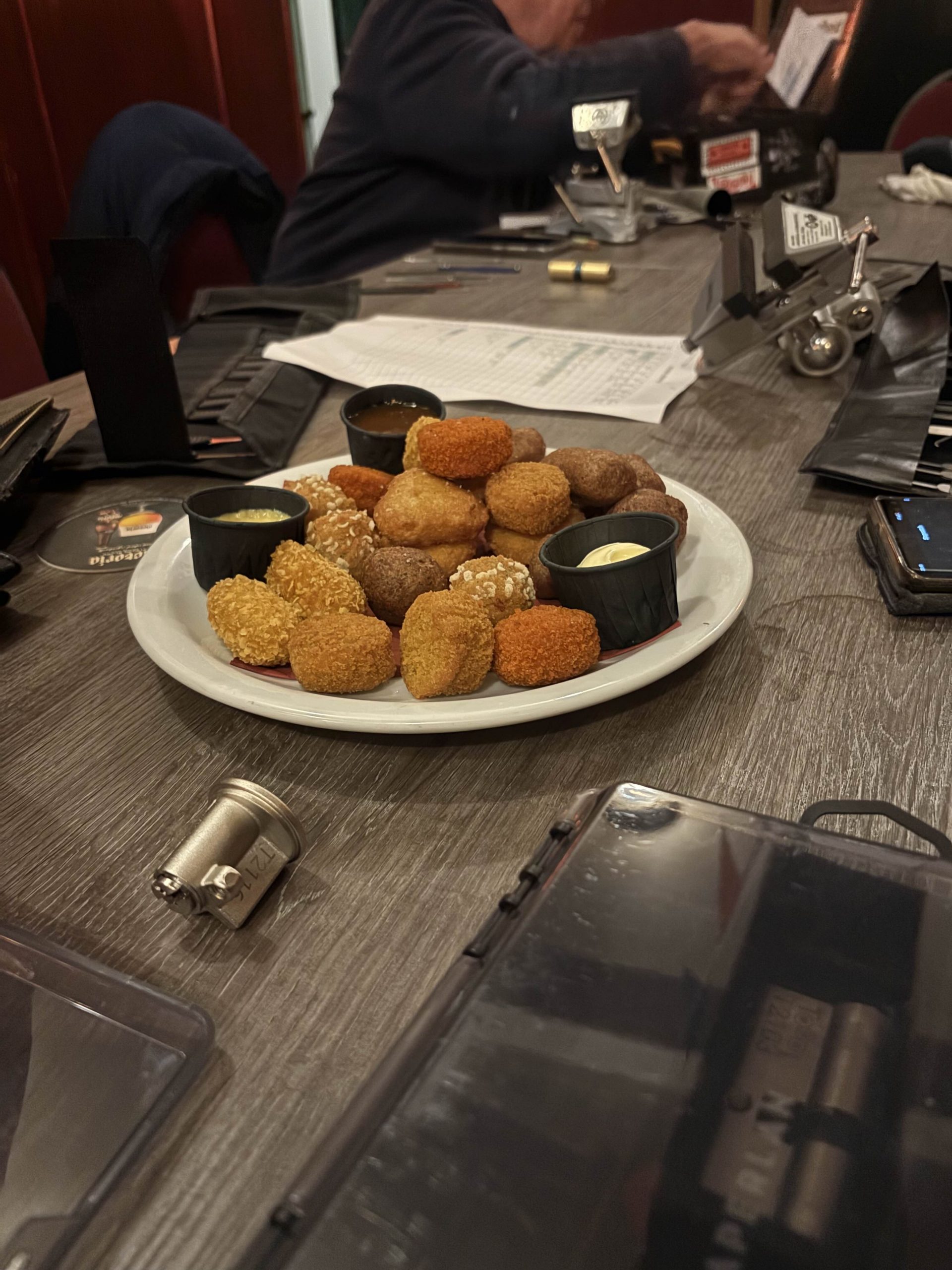
At today’s meeting, we were presently surprised when they treated us to some Dutch warm snacks.
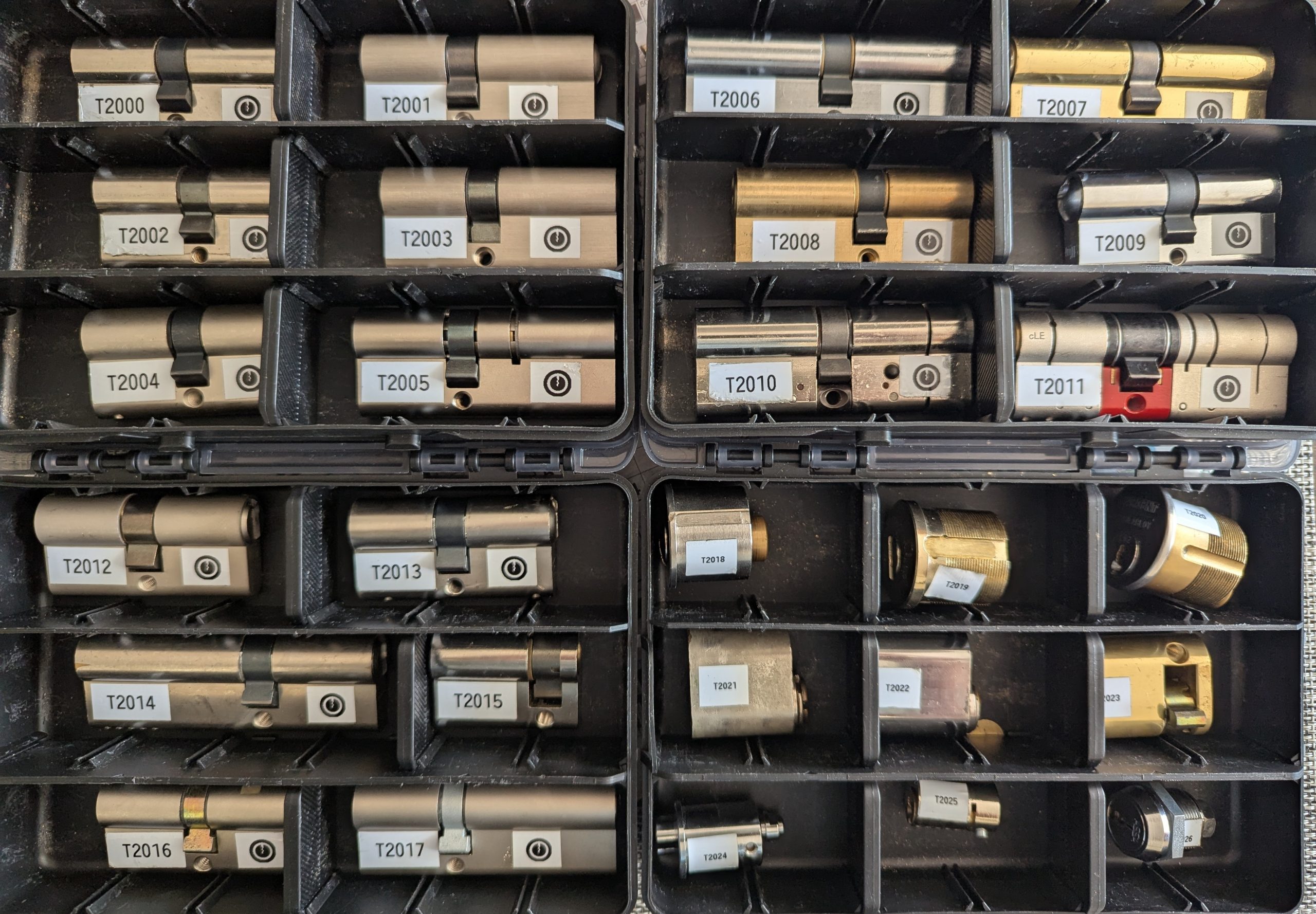
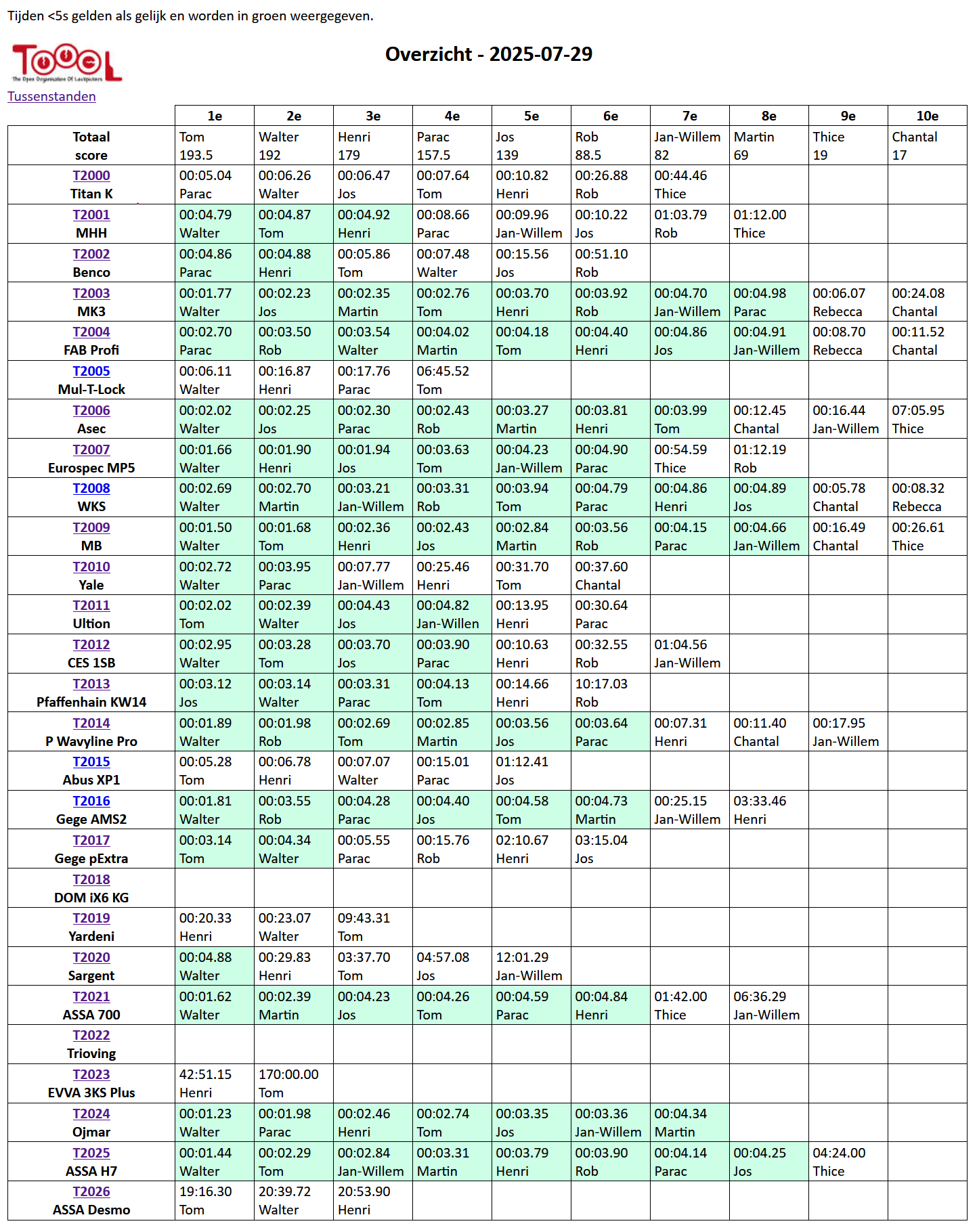
The Toool lockpicking competition is held yearly from 2004 onwards. About 25 locks are selected and it is up to the Toool members to try and pick them at Toool gatherings. They can spend as much time as they like, and can retry to open a lock as often as they like. Scores are given out depending on opening speed, 10 points for the fastest person up to 1 point for the 10th time on the lock. Since some locks can be opened with just a single rake, times under 5 seconds all count as the same time.
Every year, locks are selected on what we think are good locks, meaning: they cannot be opened in a single rake, but can be opened within the year. This year, there were 26 locks and the mix looked like this:
Having won 18 of the 20 competitions so far, I was keen to win again, but everybody is getting better! I am a very fast picker, but it is not just speed, it is also making sure you open all the locks. In the end, there were a few locks that were only opened by 5 or less people.
The Yardeni and Sargent looked simple, but turned out to be hard. The Abus XP1 was left unpicked for a long time, mainly because it has a reputation of being very hard to pick. When it turned out to be (quickly!) pickable, it got 5 openings.
Then to the hardest locks. The EVVA 3KS was my personal nemesis. There is only so much time you can practice on these locks (only during gatherings). For the first time, I resorted to practicing at home. I took an EVVA 3KS I had in my collection, created specialised picking tools and practiced until I could open it. However, the 3KS in the competition would not budge. The main problem being that, when moving some sliders, the lock would reset (which my own 3KS would not do). I’ve spent quite a few hours on this 3KS to no avail. It was opened by Henri who became third, and by Tom who won this year’s competition by 1.5 point. Congratulations Tom! The three of us opened the same locks (except the 3KS for me) but I scored higher than Henri because of my fast openings on the locks I did open.
Since a 3KS is easy to disassemble without having the key, I took a look at the insides, to see if there was anything that can explain the resetting of the lock, but everything in there seemed very normal.
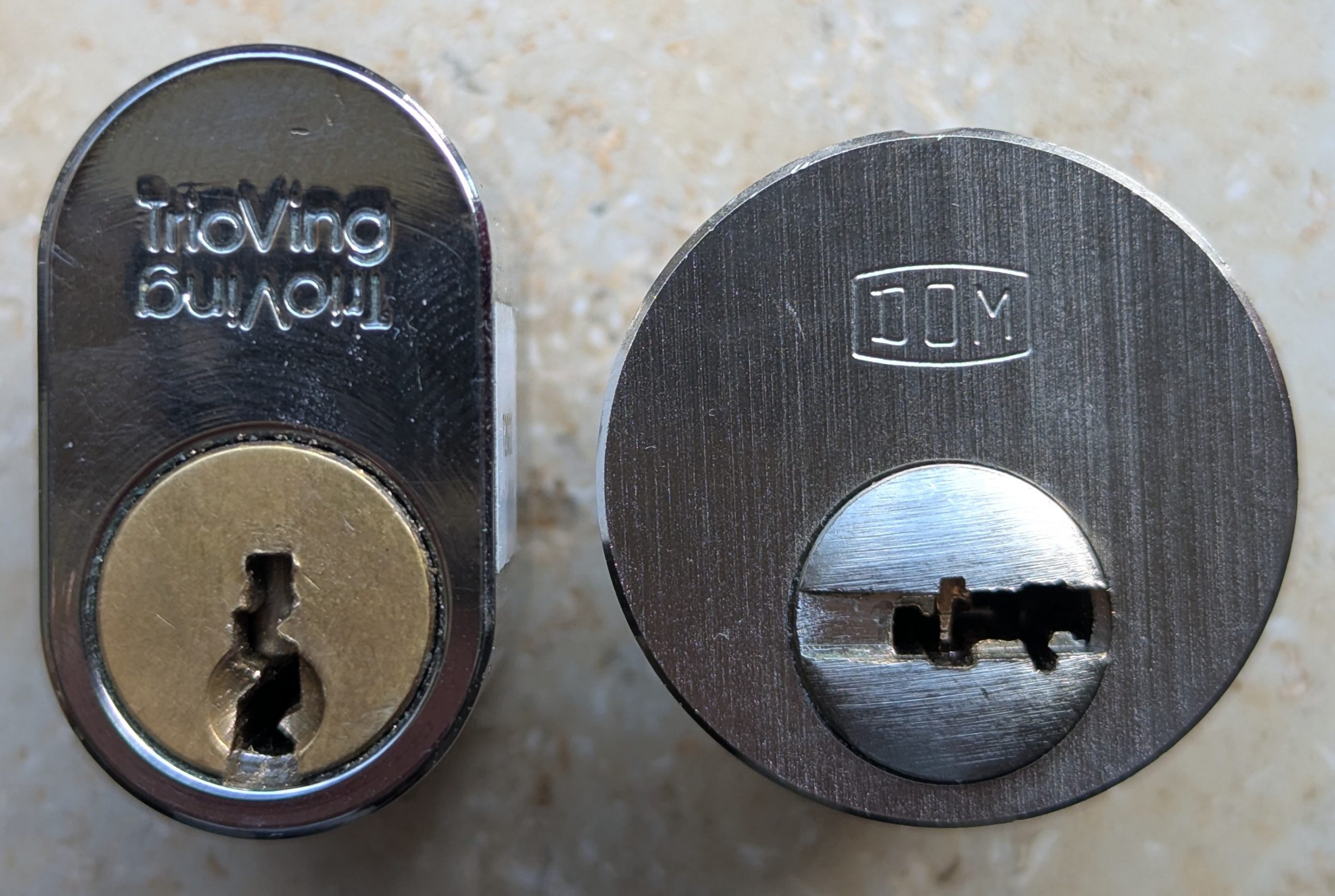
These are the two locks that no-one opened. The TrioVing does give feedback while picking, but nobody succeeded in opening it. The DOM was picked into a false set but also never opened. The pins have a shape that makes picking quite hard.
I am looking forward to the next competition. This one was exciting right until the end. The last gathering I decided to not work on the 3KS but try and gather a few points by improving times on simpler locks. At the start of the gathering, I was only half a point in the lead, and was able to gain another point by improving my time on the Benco lock. The Benco I don’t like, as I don’t really get a good feel of how to pick it. Tom was trying to open a new lock (such as the DOM above) for maximum points, but then changed strategies and improved his time on the Desmo, giving him a 1.5 point lead. I only realise now, writing this, that improving my time on the Benco with another 2 seconds would again have been enough for the win. That is how close this years’ competition was!
If you have locks you are willing to part with, please consider donating them to Toool for the next Toool NL competition. We are particularly looking for the difficult locks. Equivalent to Desmo, 3KS, Trioving, and IX6. As we are building two cases, one for us and one to share with other Toool organizations, two locks would be ideal.
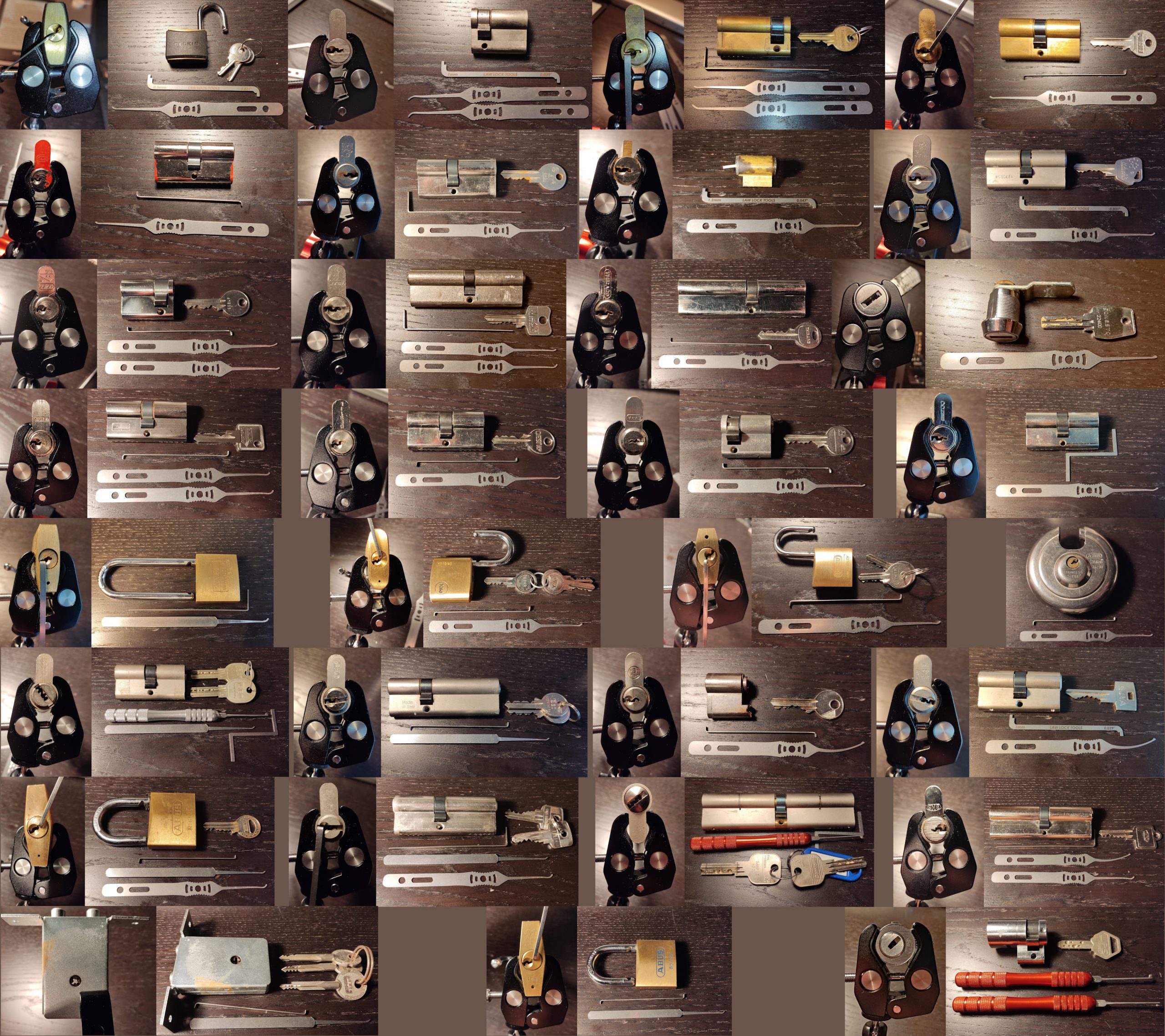
Jan-Willem wrote about the UKLS January Challenge last year. This year, Thice decided to participate, as a way to learn how to pick more types of locks. I myself started a few days too late to make it a real January Challenge. Nkt sometimes skipped a day, but then made up for it the next. But that is not a problem, the great thing about doing such a challenge is that you get to work on different types of locks, even locks you haven’t picked before. It is a nice boost when at the end of the challenge, you’ve learned some new skills!
These were the ones I picked:
Thice picked these:
Nkt not just picked pin tumbler locks, but quite a few lever locks as well.
Nkt kept the best for last, however!
Join next year if you can, or just start now! Just pick a month, or a number of days, and see where it will get you.
For this years’ LockCon, I decided to not do a lecture about a lock-related subject, but to organise a lock-themed pubquiz, the “LockQuiz”. I like the old-skool quizzen where you work together in teams and write down your answers on paper. Modern app-based quizzen have their own charm, but that was not what I was going for. When I play a quiz, I like questions where teamwork leads to the correct answer.
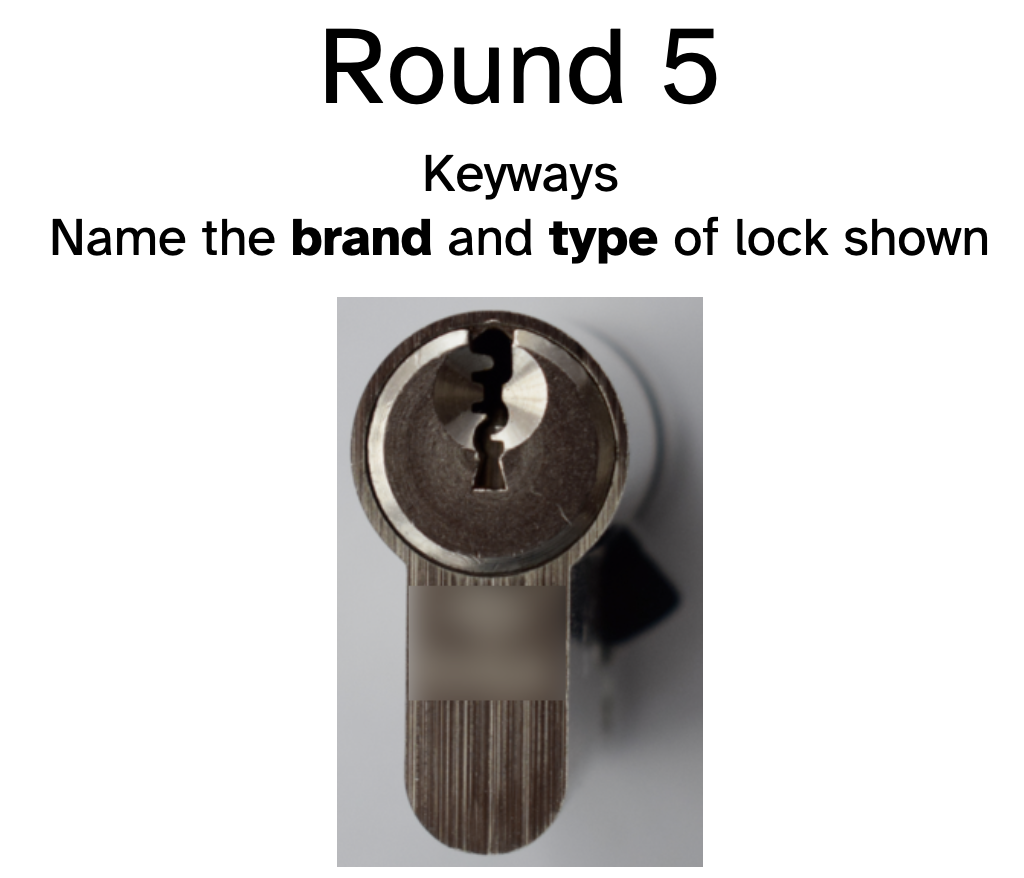
So I went about to see if I could come up with enough locksport-related questions and categories. I ended up with 68 questions in 6 rounds. In round 1, I showed lock cylinders and padlocks, with the brand name removed and the teams had to tell the brand. In round 2, lock-related books were shown, with one word (partially) blurred, the question was what the word was. Round 3 was another picture round with pictures of tools, where the question was which toolmaker the tool was from. After a small break, we continued with round 4, in which I asked for names of movies in which something lock(picking) related was shown. Round 5 showed keyways, asking for the brand and model, and round 6 was a music round, showing clips that had something to do with locks as well. Requested was the name of the artist.
I got very good feedback and everybody seemed to really enjoy the quiz. I have made generic pubquizzes before and know that the biggest pitfall is to make them too hard, which is no fun for the people doing the quiz. That is why I included answer sheets for the (rather difficult) movie and music rounds, that showed the number of letters in the answer and also had some letters filled out in advance.
The quiz had a clear winner, which was good, as I had not thought of a tie-breaker question. In the end, 77% of the questions were answered correctly, which is wonderful, as that was what I sort of aimed for, but it was hard for me to know how difficult it would be in advance. The lock brands round turned out to be the easiest, the music round the hardest, but even that round had 74% correct answers, thanks to the answer sheets.
If anybody wants me to do the quiz elsewhere, contact me. Obviously, the people at LockCon already know the answers. Or, if you have suggestions for other topics for rounds, or questions, I’d be interested in those as well. And finally, if you’ve made pictures of me presenting, I’d love to have a copy as well.
And again, congratulations to Team Baguette, who won!
At the impressioning championships in Germany at Wendt, organised by SSD e.V., I noticed somebody using a light I had not seen before. Since my own light/loupe is incredibly old and almost falls apart, I decided to buy one as well. It’s the “Maginon Tischlupe TL-120”. I bought one for €27.32 including shipping from Germany, with that price it’s worth to give it a shot.
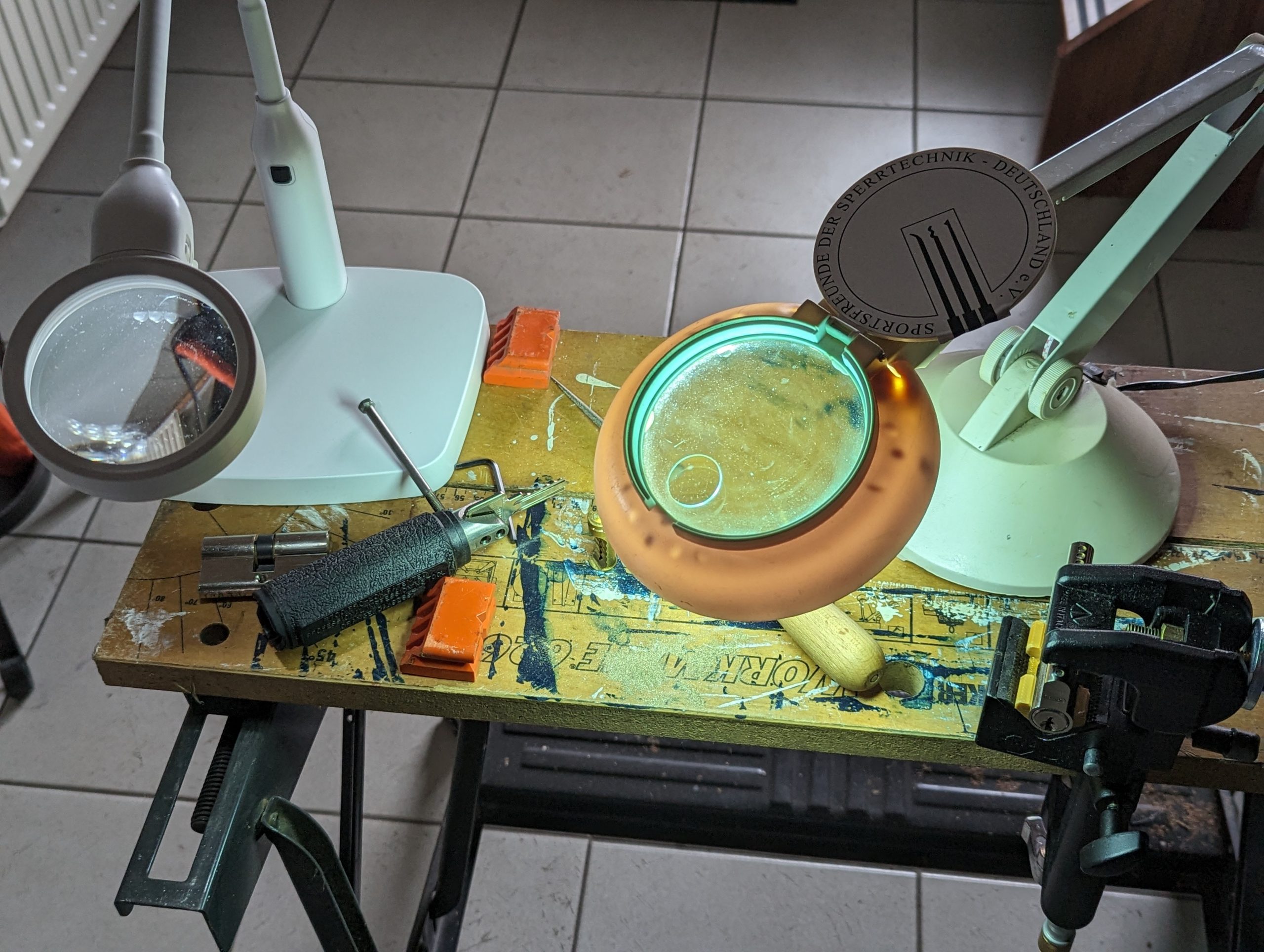
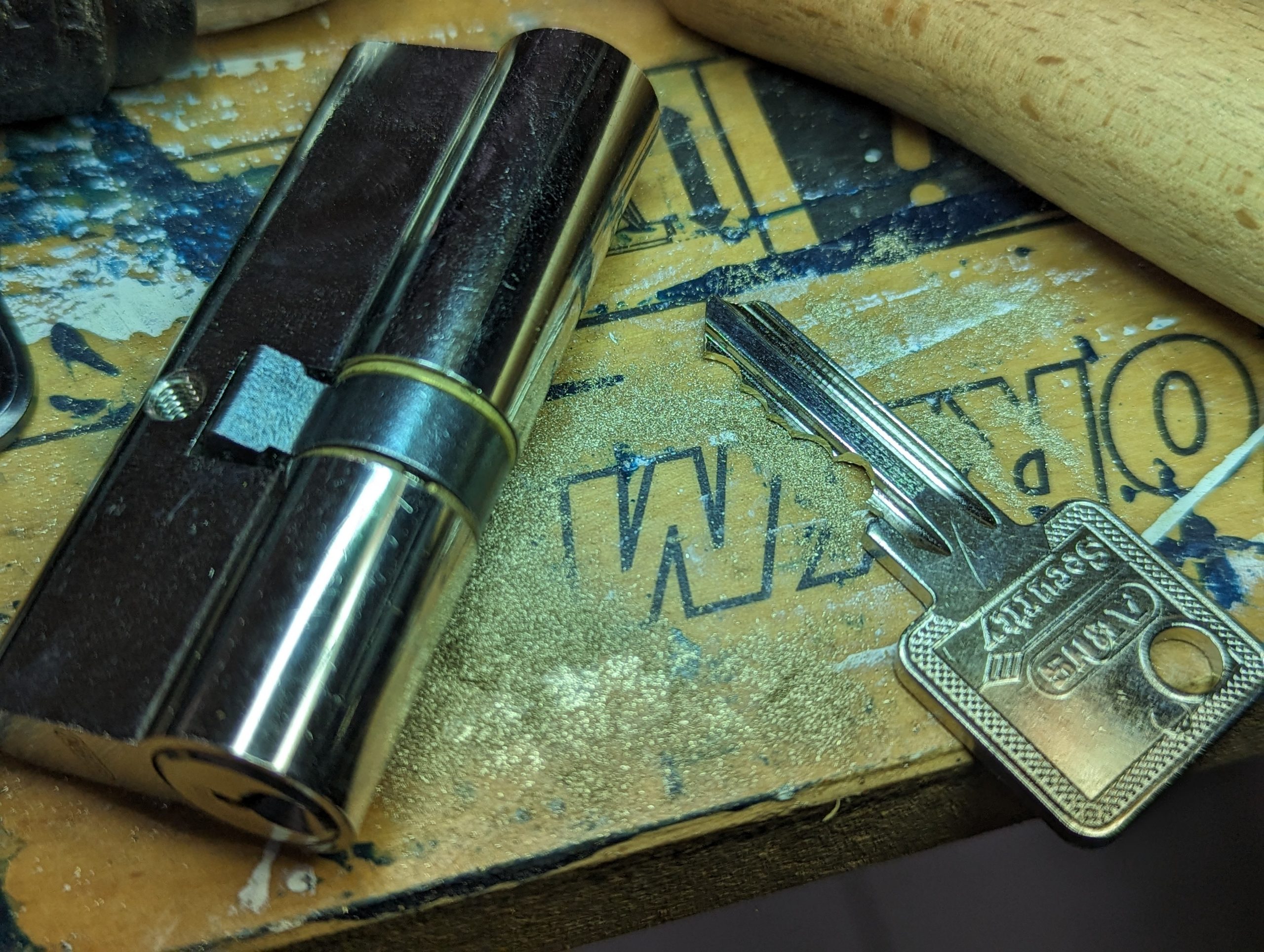
I set up a little working space to compare my old light, which has a TL light, and the new light, which uses LED.
Both are flexible. The Maginon has a nice heavy base, but you can also attach it to a table clamp (included with the light). Apart from the small loupe, there is also a bigger loupe but that does not offer the same magnification. The little ‘eye’ in the old loupe has the most magnification. The LED of the Maginon is attached just below the loupe, you can see some LEDs shining through the glass in the picture above. The LEDs can be shivelled from shining horizontally to almost vertically.
What is nice about the Maginon is that it can be battery operated (3 batteries included), or you can power it via USB-C (adapter and cable also included). The button switches between no, medium or high illumination. So I went on and filed a key, looking for marks using both loupes.
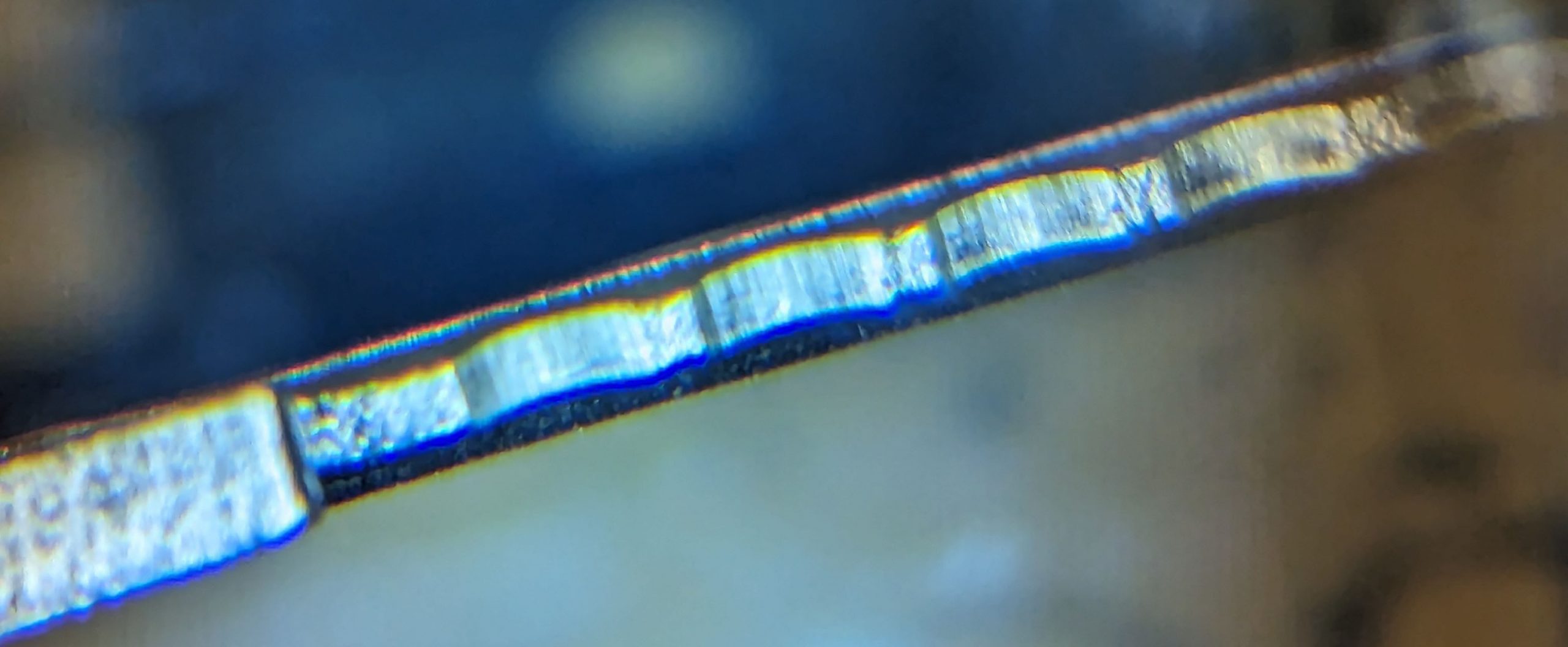
Unfortunately, I was not able to make decent pictures on the old loupe. The above one shows a distorted key which is due to the little loupe and camera interfering. In reality, the marks were visible very well.
Using the Maginon, what I first noticed was the fact that it does not magnify as much. I prefer my old loupe as far as magnification is concerned. I had to play a bit with the angle at which the LEDs are places. Shining horizontally doesn’t work well as it doesn’t illuminate the whole surface in a uniform way. Shining almost vertically causes a lot of areas to shimmer which also doesn’t work well. Putting the LEDs in about a 45 degree angle gave the best results.
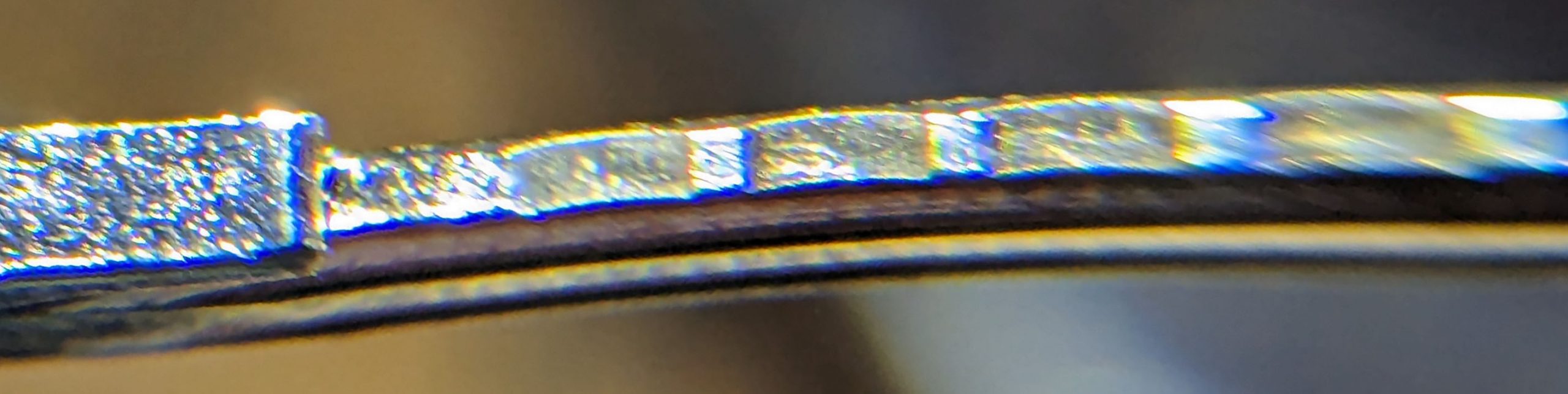
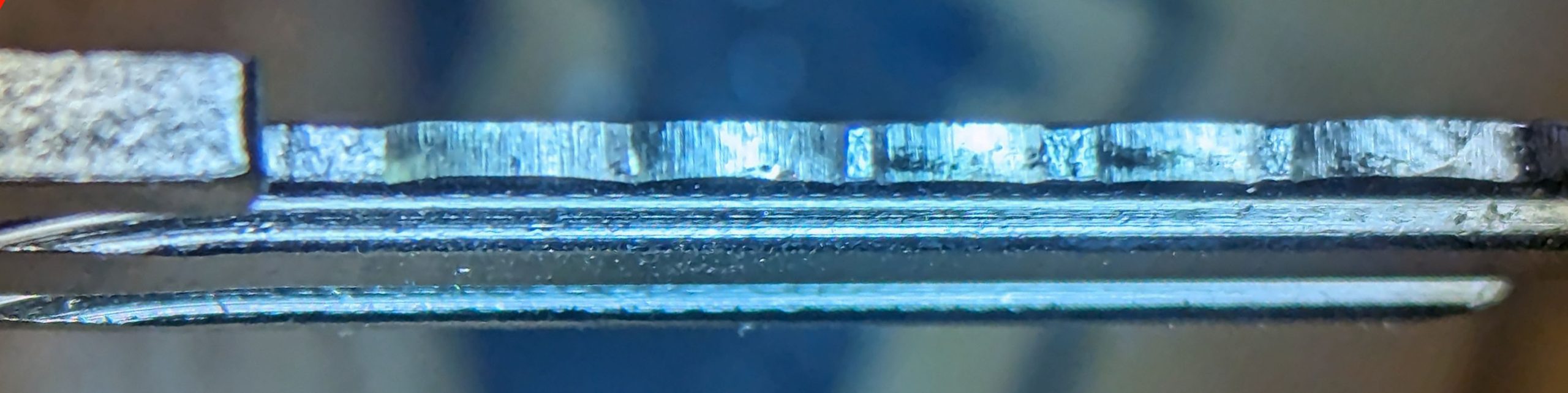
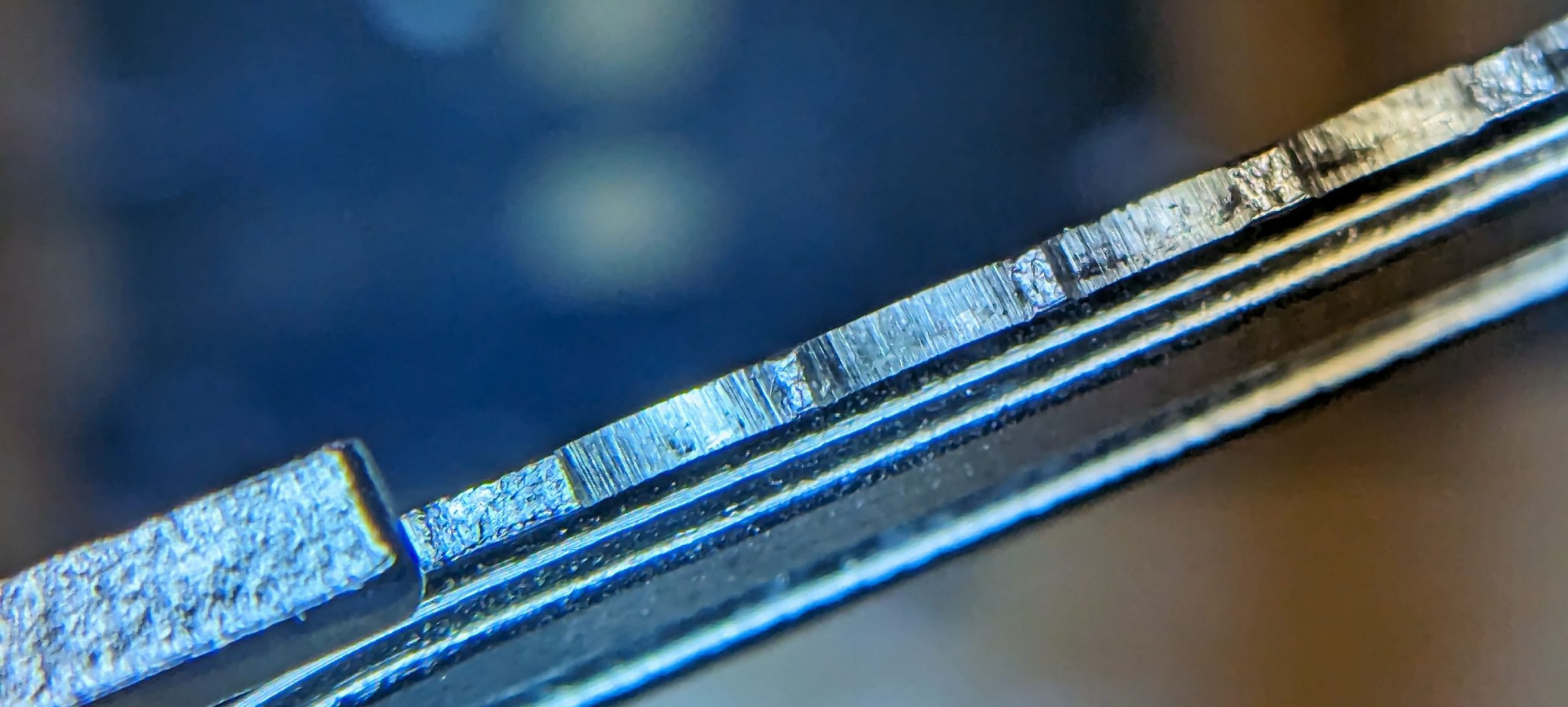
Interestingly, sometimes I saw a mark better on the Maginon than on my old loupe, but the reverse also happened. The marks of the pins riding over the key were certainly easier to spot with the Maginon. In the above picture, clear marks can be seen.
The light of the Maginon, being LED, is whiter and more unnatural than the TL light of my old loupe. The key under the Maginon shows all sorts of colourful artefacts. In the end, I prefer my old loupe, mainly because of the higher magnification. The selling points of the Maginon are its price and wireless operation. The selling points of the old loupe are the maginifaction and the natural light. In the end, I filed a working key.
I will probably take the Maginon with me to upcoming competitions, both as a backup (always make sure you have backups!) and as a device to give me a second opinion, when I doubt a mark I am seeing on the old loupe. Having a second loupe at the table could provide the mark that is needed to continue.
Yesterday, the yearly “Festival ACF” was held in Paris, France. This is a combination of lectures, workshops and competitions held by the ACF (Association des Crocheteurs de France), the French Locksport group.
I believe this must be the 4th or 5th time I visited. It was good to meet old friends and make new friends. The first lecture I saw was from a pentester, talking about a red teaming assignment (that did not involve physical security). Next was a historical overview of pump locks from Fichet-Bauche.
After that, the lockpicking championships were held. About 25 people participated. In the first round, people were seated at tables with at most four people, each having to pick three cylinders in less than 5 minutes. I got an Opsial, a Thirard (which felt very cheap) and an unbranded cylinder. The Opsial was my first and I made the mistake not to try and rake it. I spent too much time picking and though I made not even make it past the first round! But in the end, it was me and Wesley both going through, thanks to our quick raking of 2 (me) or 3 (Wesley) cylinders.
The second round I had 2 opponents, and the cylinders were more difficult, a TESA TE5, a Heracles and a Vachette V5. They needed to be picked in under 10 minutes. I opened them all and my opponents opened none, which meant I was in the final!
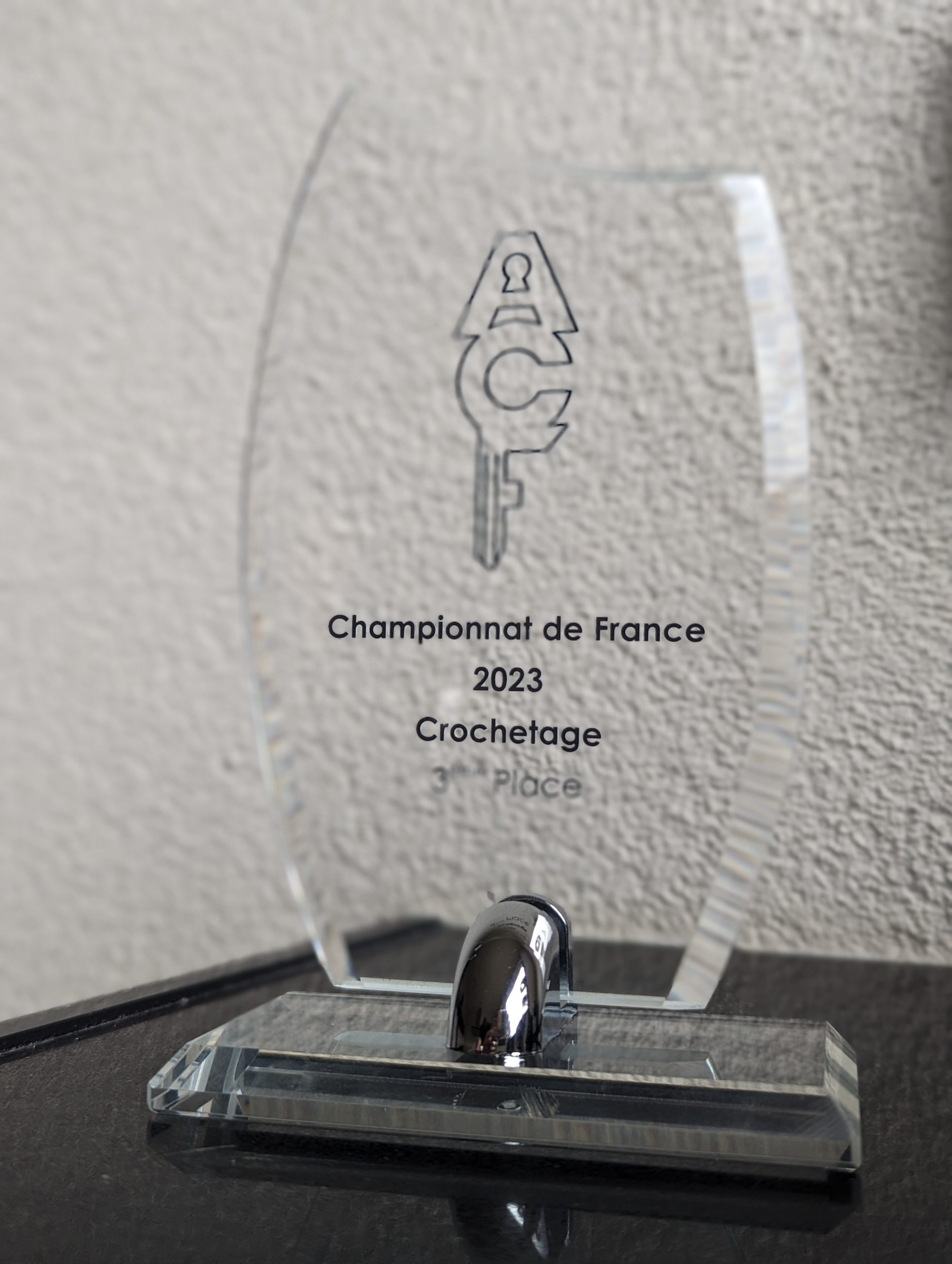
There were 4 people in the final, having to open 4 locks (BKS 6-pin, DormaKaba, Heracles with a horrible keyway and a GeGe). I needed to relax and try to open something, as I hoped to get a plaque to take home with me. The BKS I could not open, but the DormaKaba I did open in 13’11, so just within the 15 minute time limit. And that was the only one I opened.. Nitiflor opened the DormaKaba as well as the GeGe, Wesley opened just the GeGe (in 9’20) and Hadrian did not open any. Too bad I could not open the GeGe as well, as that would have yielded second place. The final result was: Nitiflor #1, Wesley #2, I came third and Hadrian fourth. But that meant I got a plaque!
The ACF had gotten some really nice sponsoring resulting in nice prizes. Nitiflor got the wonderful Multipick ARES disc detainer pick, Wesly the Kronos electropick, I got a Flipper Zero. And some more goodies including some cylinders (DOM iX TECO, M&C Minos) and a manual pickgun.
I hope to return to Paris next year, and maybe win another plaque. Although my scores are declining, in 2021 I became first (and second in impressioning), in 2022 I became second, this year third. I see a downward trend 😉
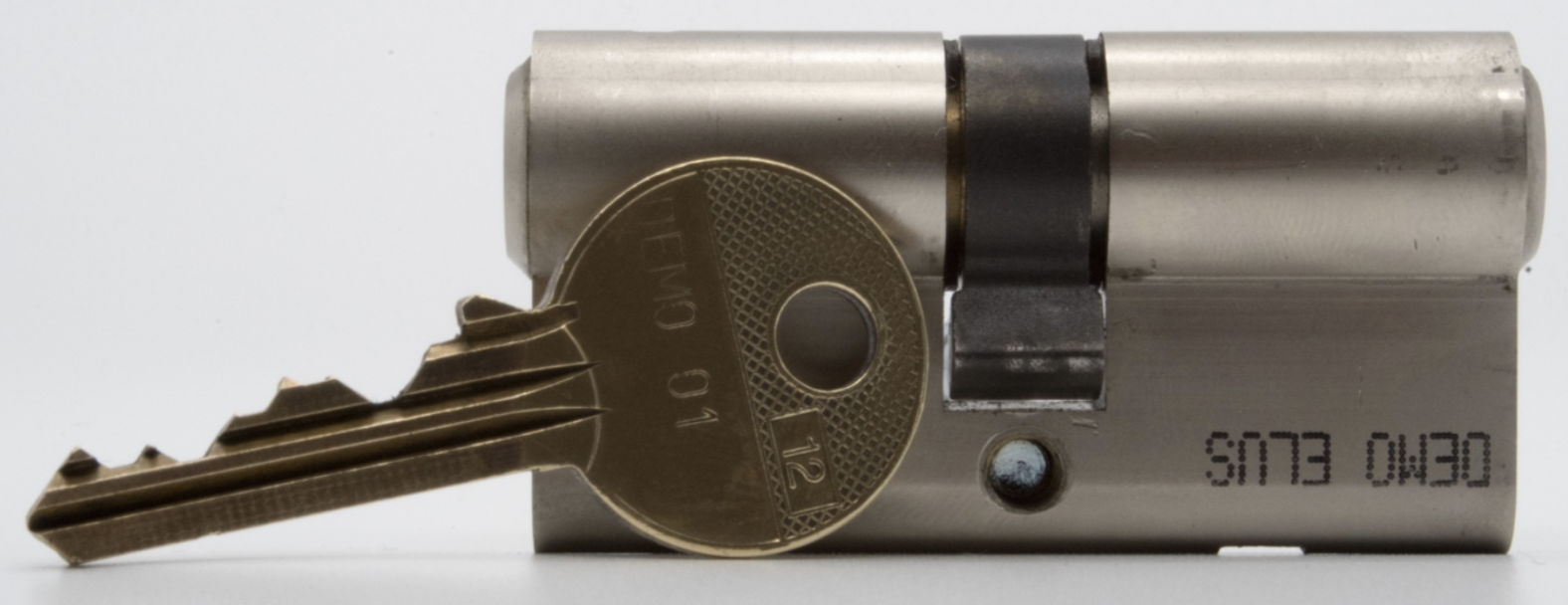
I recently acquired an EVVA cylinder stamped “ELUS”. Nothing could be found about it, so I decided to investigate it.
Looking at this picture, it looks pretty standard. It is a variation of the EVVA NL system, which is inself is a variation of the TSC system. The NL is a 5-pin cylinder with multiple possible key profiles and with master keying in the bitting.
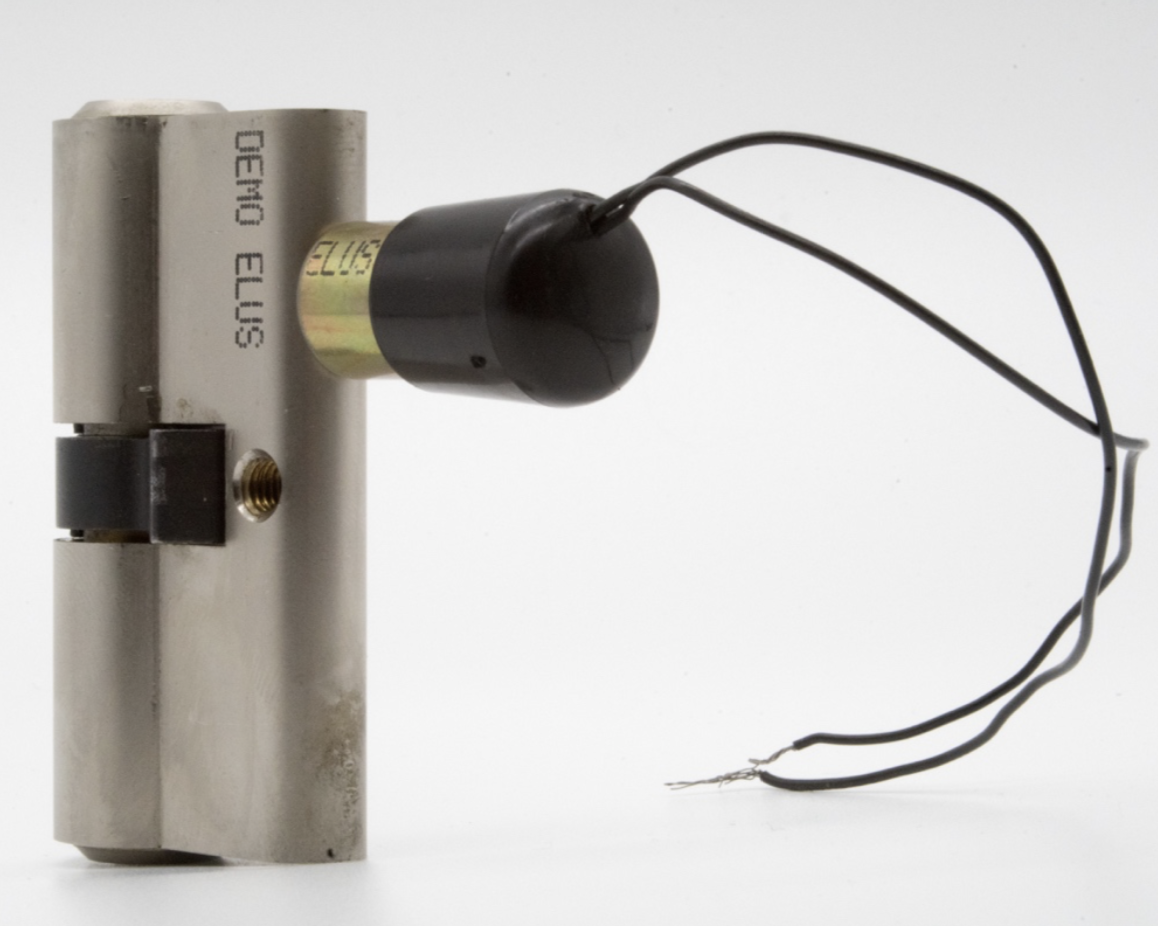
But: this system has additional electronics attached to it:
The electronics implement a Temporary Access Function, similar to that in the EVVA ICS TAF cylinder, invented around 25 years later than this. It was an invention of EVVA Netherlands with one of their partners, but it never reached production.
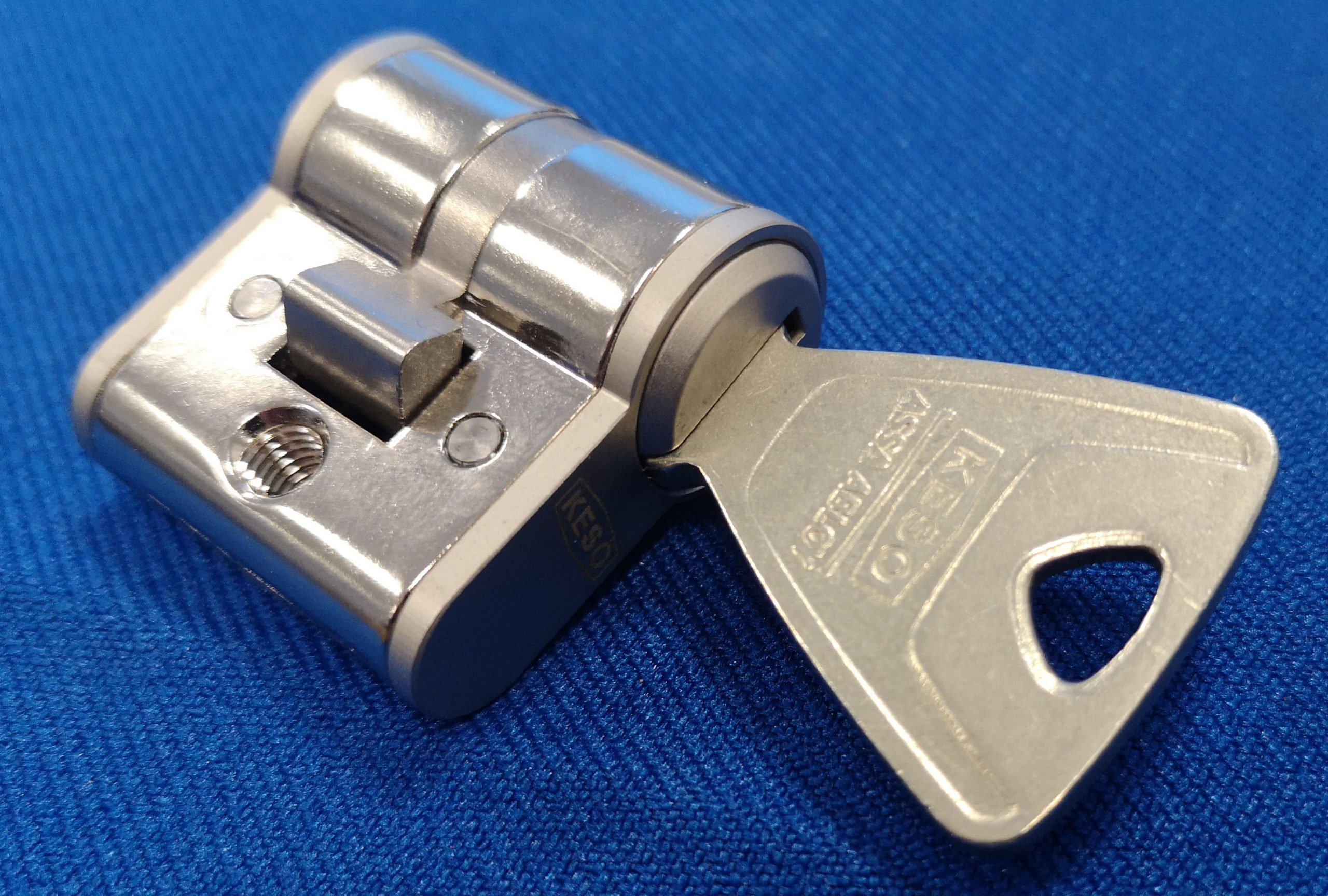
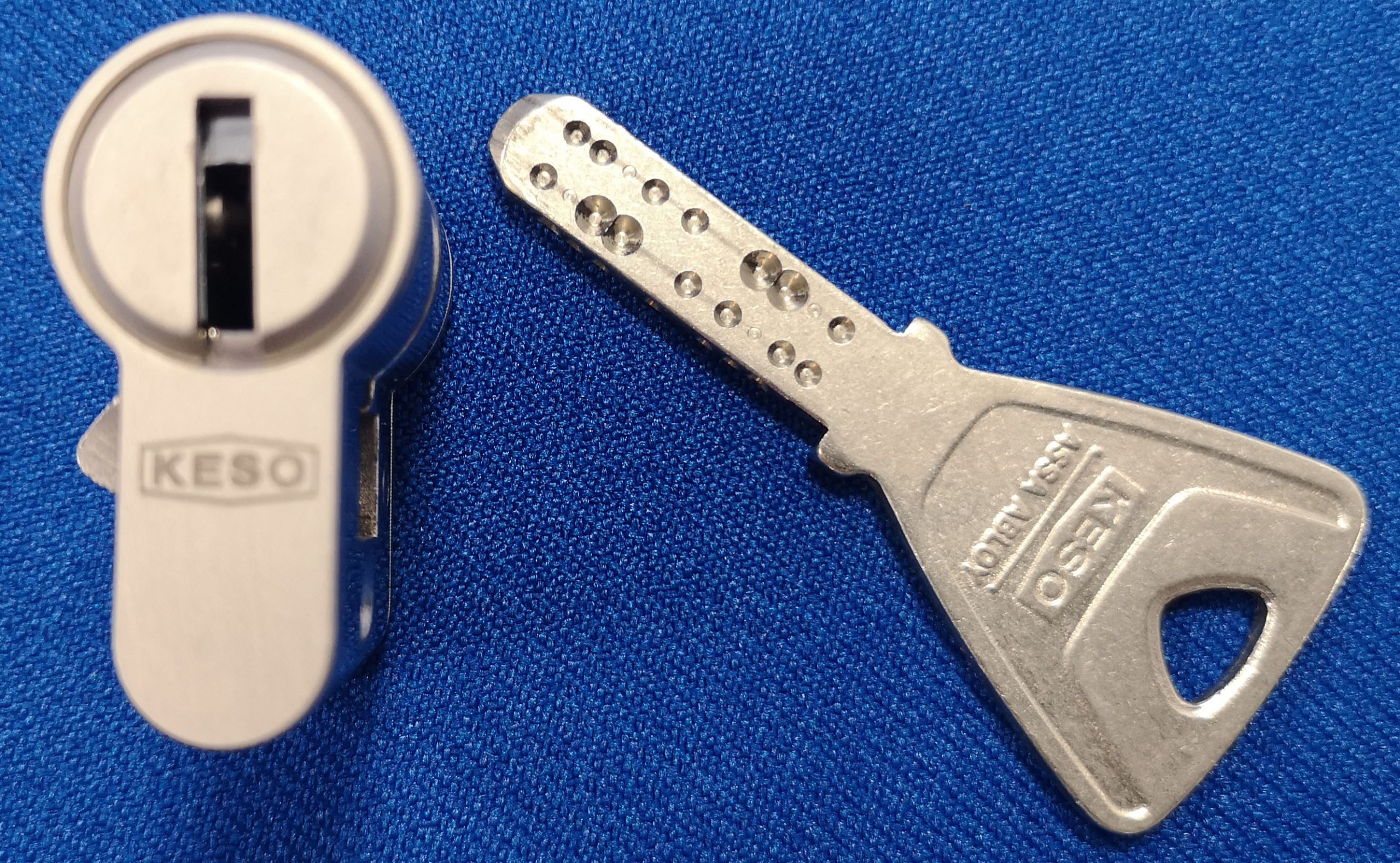
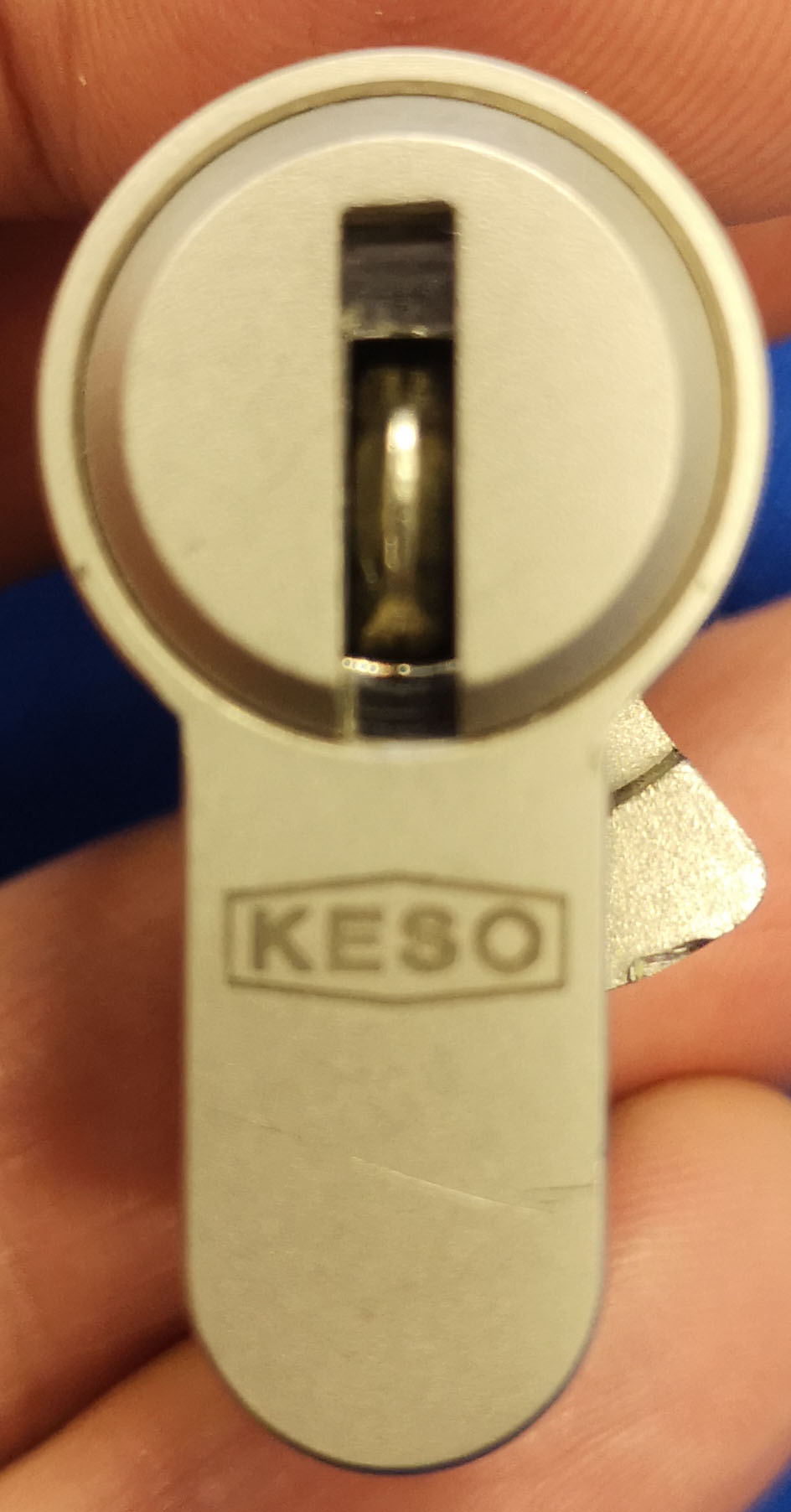
This weekend at the Wendt lockpicking event, I spoke with the gentle people from BESA specialty lock shop in Belgium. They brought with them a very intriguing cylinder. It’s a KESO Octro 4000S dimple cylinder, but what makes it special is its size: it is a 14/14 cylinder (total size 2.8 centimeters).
The key is a normal sized key. It goes all the way through the cylinder. That means that the bitting interacts with pins on both sides of the key, which in turn means that the key must be symmetric.
Indeed it is. When the key is inserted, you can see it while looking at the other side.
By looking at the key, there could be as many as 30 pins in there. Not bad for a 14/14 cylinder, especially when you compare it to the 20/20 cylinder that had just one pin I wrote about earlier (see https://blackbag.lockcon.nl/?p=3882)!
If you have one of these to spare or know where to get them, let me know.
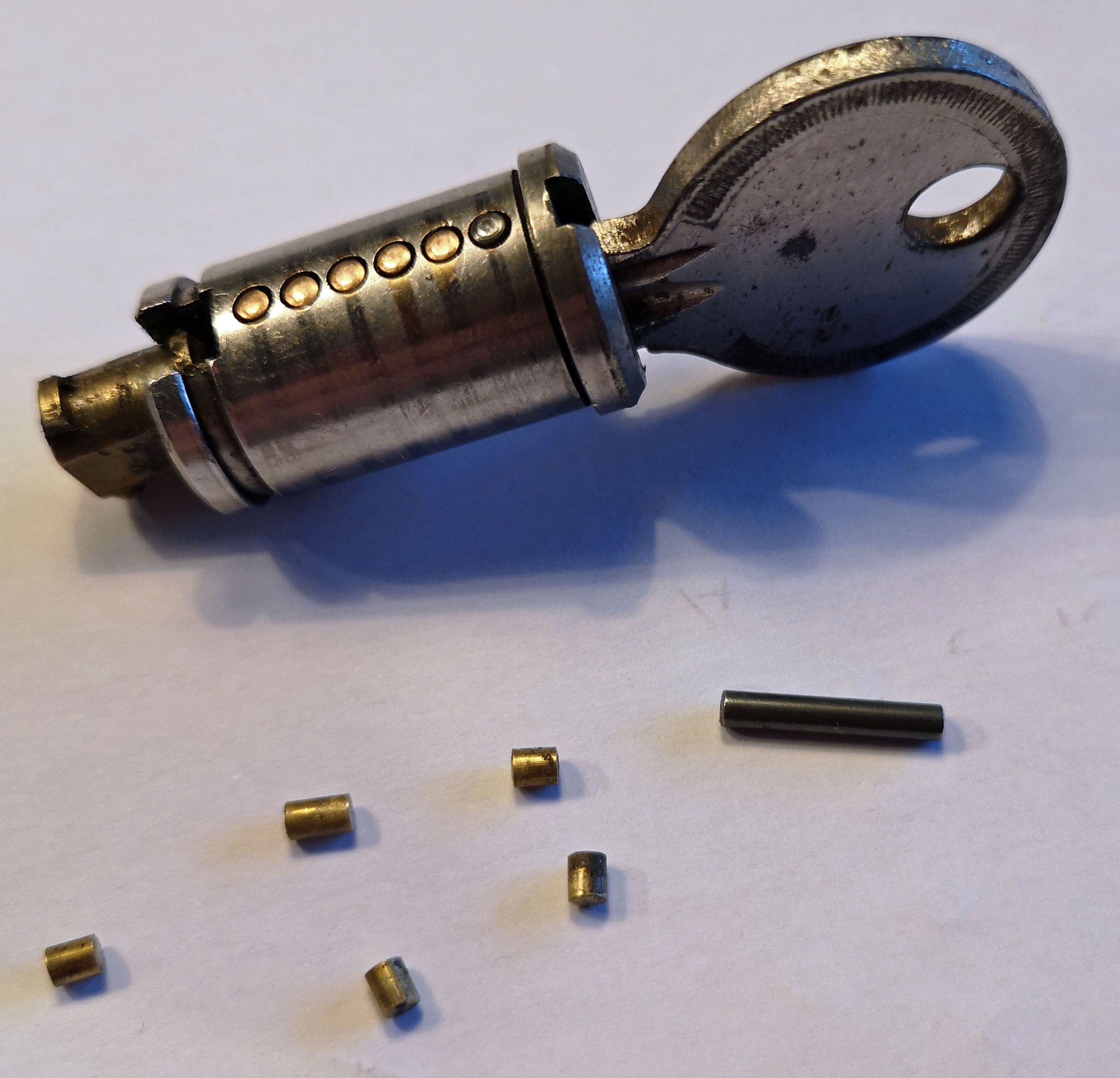
I got some new (old) cylinders. One was a small 25/25 cylinder with the key stuck in it. When I disassembled it, I was amazed to see six pins instead of the maybe three I was expecting.
The housing pins were tiny and also very short, except for one tall one, that has a double function as an anti-drill pin. The corresponding key pin is also made of hardened steel. There is one regular housing pin that is longer than the others. You would expect the key to have one cut that is deeper than the others, but that is not the case.
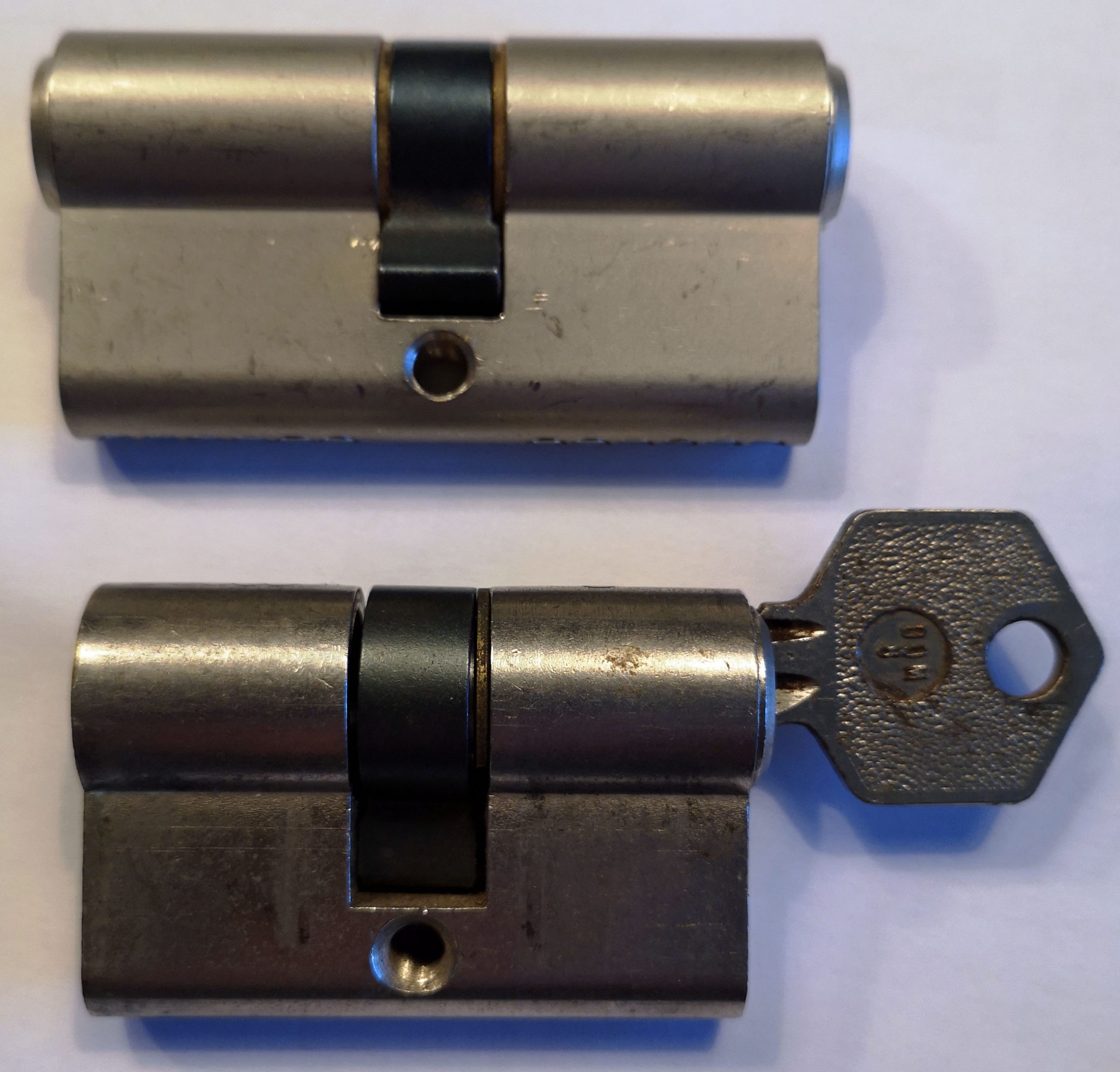
After reassembling, the cylinder worked fine again. Here’s a comparison of the key to this cylinder with one of a regular 6-pin cylinder: